Object Path
Grounding DINO locates the prompted object, SAM2 tracks its mask, SAM3D builds a textured mesh, and FoundationPose estimates a smoothed 6D pose trajectory.
Package Docs
Turn human demonstration video into geometric reconstructions with the reconstruction components available in Video to Data.
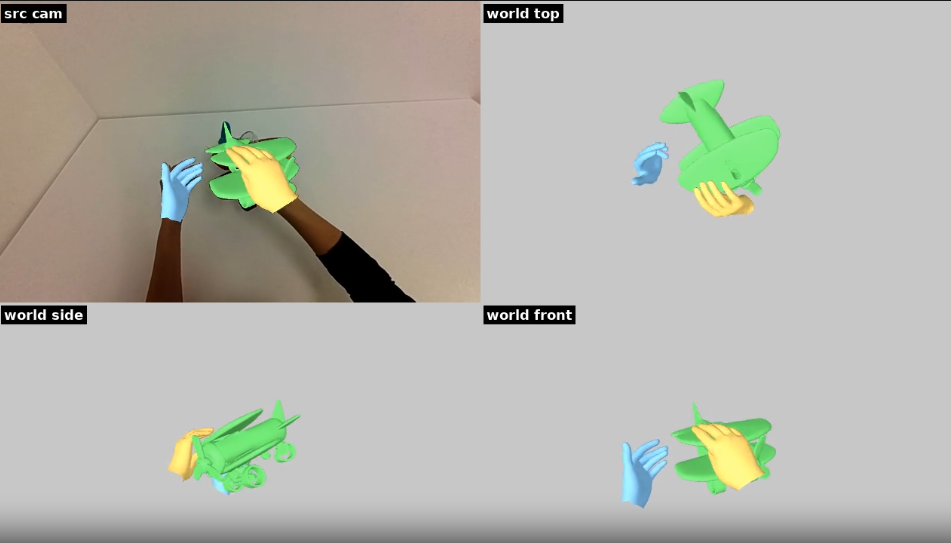
Video to Data includes a variety of reconstruction packages for recovering human, hand, and object trajectories from demonstration video. These outputs can be used by downstream tasks such as motion retargeting, robot simulation, policy training, and dataset analysis.
All reconstruction components are containerized with scripts to easily build and execute them. This makes reproducing results straightforward.
Video to Data includes a pipeline for ego-centric hand-object reconstruction, detailed in ego_e2e_setup.md. Given an MP4 and a text prompt for the held object, it estimates the object, hands, depth, pose trajectory, and final alignment.
Grounding DINO locates the prompted object, SAM2 tracks its mask, SAM3D builds a textured mesh, and FoundationPose estimates a smoothed 6D pose trajectory.
Ego hand reconstruction recovers hand motion, converts hand records and intrinsics into pipeline formats, and re-expresses tracks for alignment.
MoGe depth provides the metric cues for mesh scale estimation, object tracking, EKF smoothing, and hand-object alignment.
The pipeline writes overlay and multi-view videos so object poses, hand tracks, and alignment quality can be checked without opening raw artifacts manually.
The multi-view pipeline reconstructs human motion and object trajectories from synchronized, calibrated camera views. It combines stereo depth, human and object segmentation, object pose tracking, and human body reconstruction to produce temporally aligned 3D representations and visualization overlays.
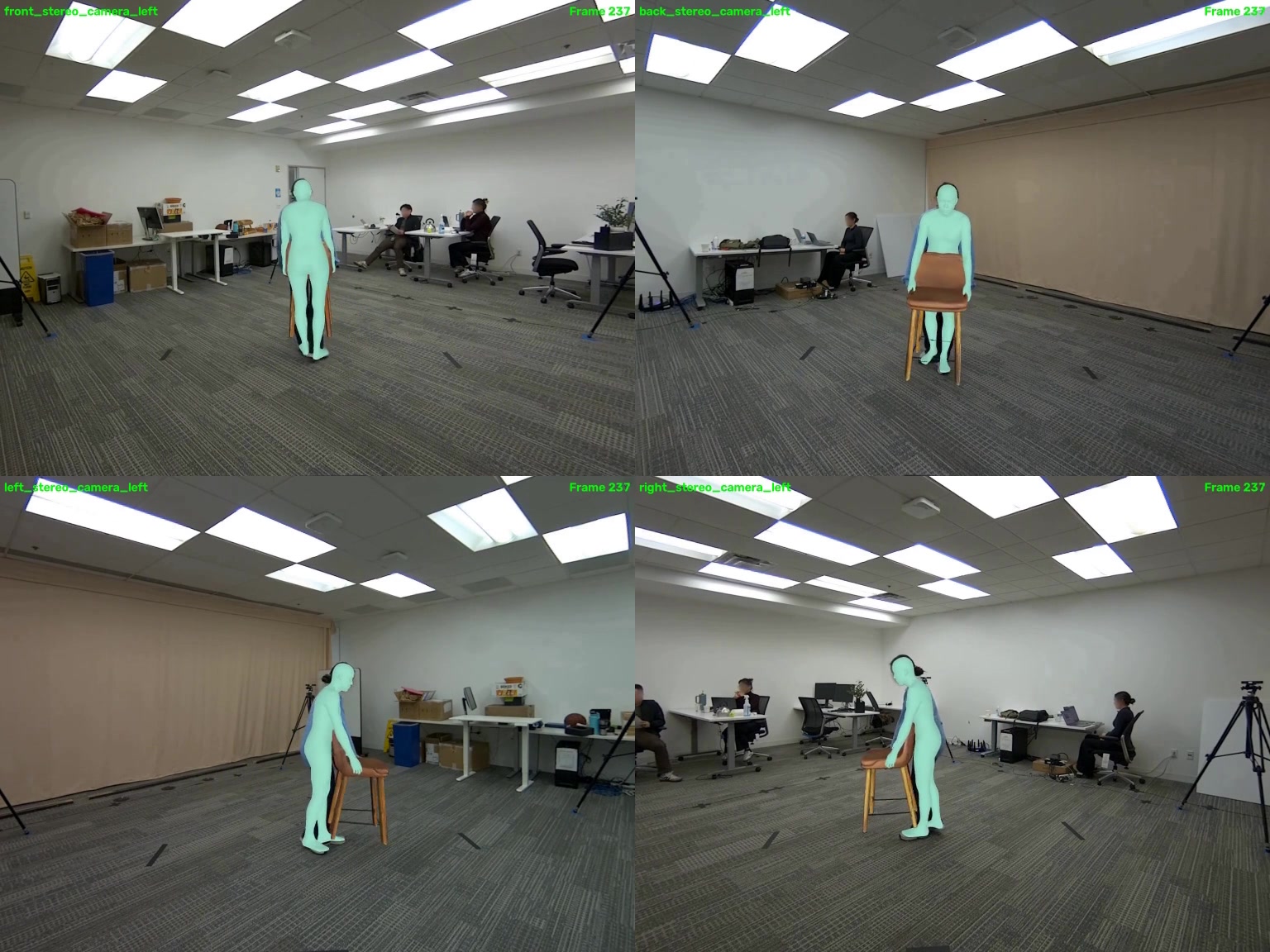
See the local multi-view calibration and reconstruction guide for setup, camera calibration, and instructions for running the pipeline.
This pipeline is used to produce the FORM-HOI dataset. FORM-HOI v0.1.0 is now available on Hugging Face, providing multi-view recordings paired with reconstructed human and object trajectories. A full technical report describing the dataset and reconstruction pipeline is coming later.
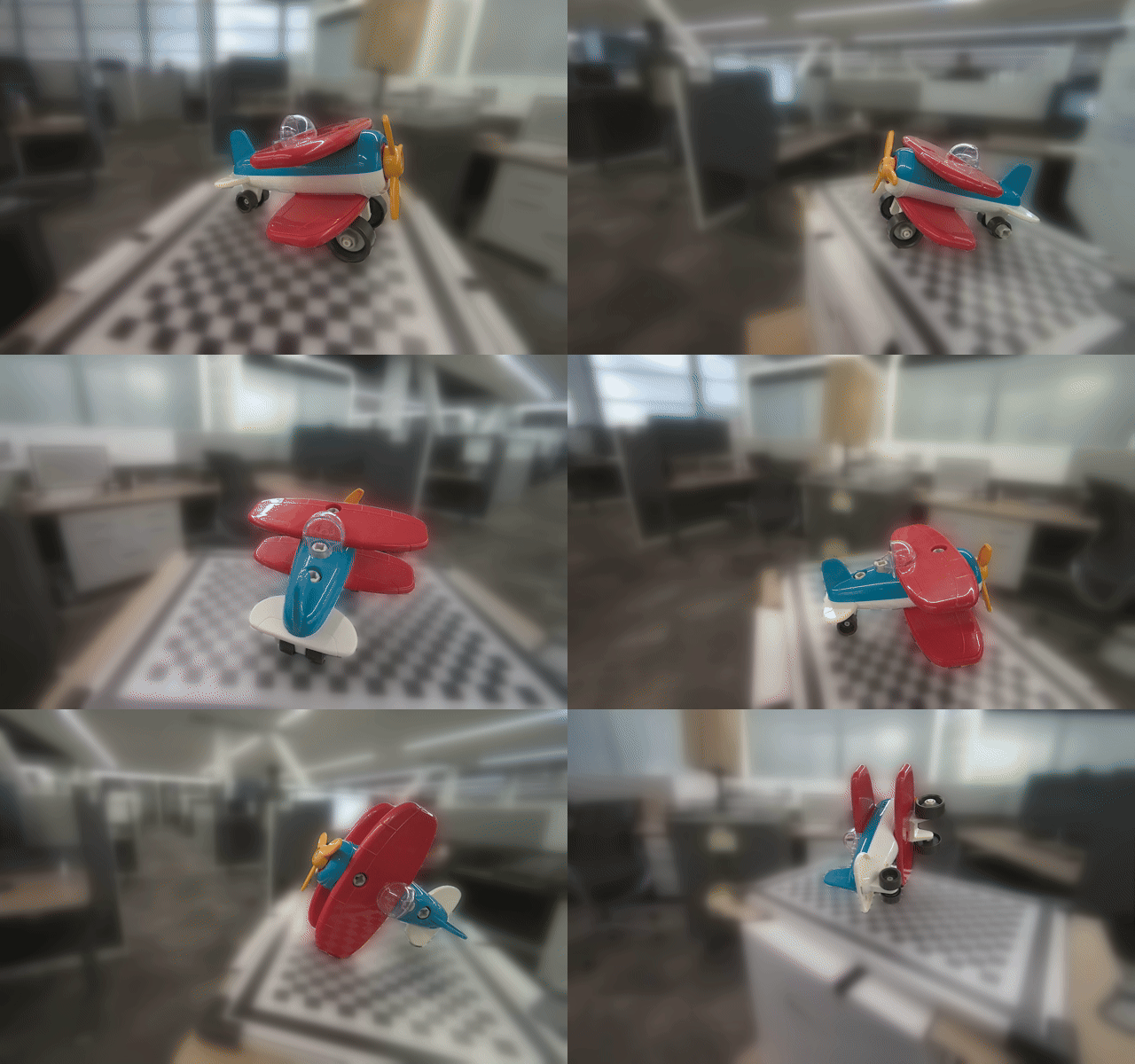
As of v0.2.0, Video to Data now supports object mesh reconstruction using a variety of methods. BundleSDF reconstructs a textured mesh from a multi-view scan, while SAM3D generates representative single-image meshes with silhouette-based scale estimation. A predefined object mesh can also be used when a suitable asset is available. See v2d_hoi_object_reconstruction/README.md for capture requirements and usage details.
A run produces a structured output directory with extracted frames, depth maps, camera intrinsics, object masks, a textured object mesh, raw and smoothed object poses, hand reconstruction records, aligned hand tracks, and rendered diagnostic videos. The key reusable outputs are the scale-corrected object mesh, the smoothed per-frame object poses, and the depth-aligned hand records.
The pipeline is resumable: each step checks for its existing artifacts and skips completed work, which is important for long GPU reconstruction jobs and model-comparison runs.
The full setup guide still lives in the repository while this web page is expanded with installation steps, diagrams, examples, and generated references for module entry points.