V2D Challenge
CHALLENGE Registration open

Video to Data (V2D) Challenge

From Human Video to Grounded Data

Where does the pipeline from human video to grounded data break? Three coupled tracks answer this with shared task suites: 4D reconstruction, robotic grounding, and end-to-end egocentric transfer.

Register Now Tracks Awards Timeline Leaderboard More Than a Leaderboard Starter Toolkit

Why This, Why Now

Human video has the potential to be the largest and most scalable training corpus for robotics; every ingredient needed to use it is ready at once.

Ready now
01
VLA and WAM are scaling beyond what teleoperation data can support.
02
4D human-object reconstruction can now produce digital twins of the real world for robots to learn within.
03
The advancements in humanoid and dexterous-hand hardware have narrowed the morphology gap between human demonstrations and deployable robots.
04
With massively parallel GPU simulation, human demonstrations can be transformed into deployable robotic skills through RL and generate diverse, physically grounded data at scale for model pre- and post-training.
Still missing

What is still missing is measurement and scale.

Measurement, because existing benchmarks evaluate stages in isolation. Without evaluating every stage on the same tasks end-to-end, the field cannot localize where a pipeline breaks, trace how errors propagate, or quantify the downstream value of improving each component.
Scale, because success on a small, curated benchmark does not show whether a method will remain robust across thousands of tasks, objects, behaviors, and environments.
This challenge
This challenge supplies both. For measurement, we provide a representative benchmark that evaluates individual stages and the end-to-end pipeline under shared tasks, spanning both third-person and egocentric human video. For scale, participants develop and validate their solutions on a curated subset of our large-scale in-house dataset with held-out ground truth, supported by an end-to-end baseline. After the challenge, we evaluate the top solutions on the broader dataset to determine how well they generalize and perform at large scale.

Challenge Tracks

TRACK 01

Reconstruction

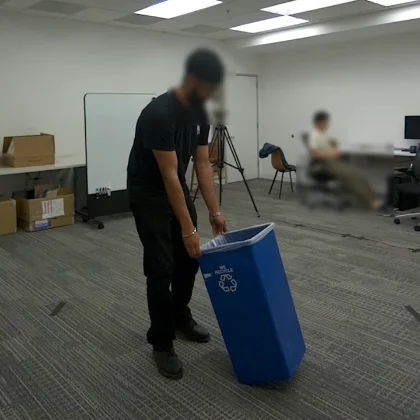
Third-Person-View Video → 4D HOI
Can we reconstruct 4D human-object
interaction from monocular video?
Third-Person-View Video
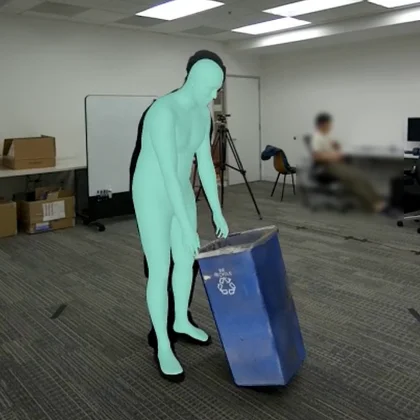
4D HOI

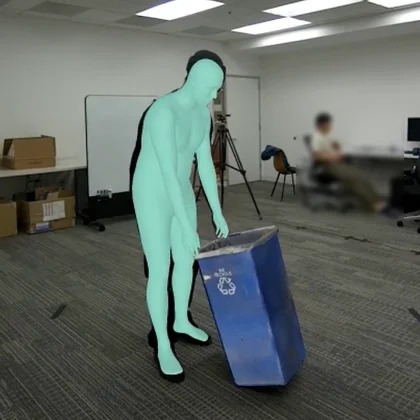
One RGB camera, third person, no rigs, no depth — the setting that scales to internet video and low-cost capture. From a single clip, teams recover the full 4D scene: human body, object pose, and geometry, in metric scale and a consistent world frame. This track identifies the frontier of monocular HOI reconstruction, allowing practitioners to calibrate future stages to the errors expected when applied at scale.

Data. Our third-person RGB video dataset with held-out ground truth. This dataset includes challenging scenarios such as heavy occlusion, bimanual coordination, and long horizons.

Submissions. Teams will submit reconstruction results for the test split using the eval_reconstruction.py script to produce the artifact for submission.

Evaluation. Results will be evaluated on 2 axes against a multi-view reconstruction (MV) baseline, representing an upper bound.

  • Axis 1, Accuracy: chamfer distance to MV human mesh, chamfer distance to MV object mesh
  • Axis 2, Physical Plausibility: acceleration error of joints compared to MV, acceleration error of object compared to MV, contact penetration compared to MV

Each axis is weighted equally when awarding points.
TRACK 02

Robotic Grounding

Third-Person-View 4D HOI → Policy
How much reconstruction error
can be tolerated?
Third-Person-View 4D HOI
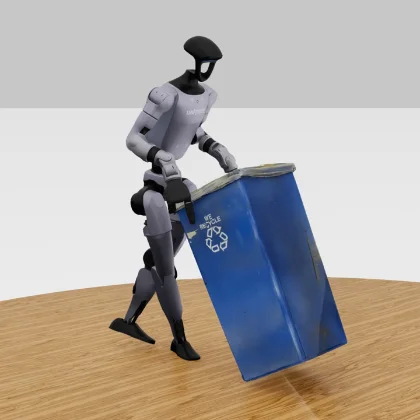
Policy
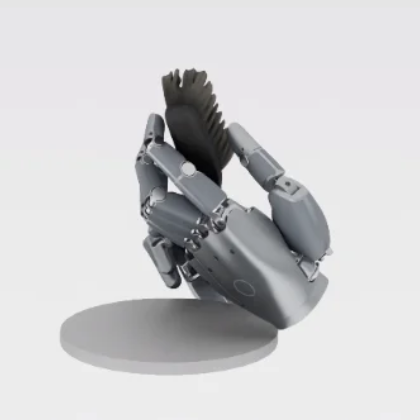
Embodiment and simulator are fixed and provided: G1 + Dex3, so entries compete on retargeting and policy learning, not simulation engineering. Teams turn human demonstrations into robot policies at varying levels of noise and inaccuracy. This track identifies the tolerance of human-to-robot transfer pipelines to errors and noise from upstream reconstruction.
TIER 1 Clean multi-view caption, representing an upper bound for upstream reconstruction.
TIER 2 Synthetic corruption: jitter, dropout, and contact errors are sampled from Track 1's error distributions.
TIER 3 Off-the-shelf reconstructions. Today's best practice.

Submission. Teams will submit recorded evaluations of their trained policies using the eval_robotic_grounding.py script provided to produce the artifact for submission.

Evaluation. At each tier, submissions will be evaluated for object-tracking accuracy using AUC, SP-SR, MP-SR, and MPPE as defined in the CHORD manuscript. Strong performance on more challenging tiers will be weighted appropriately when awarding points.

TRACK 03

Egocentric

Egocentric Video → Policy

Can we holistically reconstruct
and transfer from egocentric video?

Egocentric Video
Policy
Unlike motion capture and other data-collection approaches that require extensive equipment and infrastructure, the egocentric view can scale because it can leverage low-cost and accessible capture devices. This track critically evaluates the overall pipeline end-to-end, from egocentric videos to robotic skills.

Data. The provided testing dataset is curated from our large-scale in-house dataset with held-out ground truth. We provide an end-to-end baseline that participants may build upon, modify, or choose not to use.

Method-agnostic. This track holistically evaluates the end-to-end results without constraining the overall approach, whether through explicit reconstruct-then-retargeting or implicit end-to-end learning with pre-trained VLA or WAM.

Submission. Teams will submit reconstructions and recorded evaluations of their end-to-end pipeline using the eval_e2e.py script to produce the artifact for submission.

Awards

Three per track, nine total, announced at the CoRL 2026 tutorial.

  • Track Winner: first on the track leaderboard.
    Prize: To be announced at launch
  • Track Runner-Up: second by the same metric.
    Prize: To be announced at launch
  • Industry Innovation Award — selected by an invited industry panel, independent of leaderboard rank, judged on the final submission and report against criteria published at launch: [deployability, data and compute efficiency, novelty, reproducibility].
    Prize: To be announced at launch

Eligibility for all awards: a valid final submission, agreed code release (research license), and the short technical report. Organizer entries are non-competing.

Top teams will be invited to present at our CoRL 2026 tutorial, with remote participation available, and selected solutions will receive large-scale evaluation and upstream integration. Awardees will serve as core authors of the post-challenge technical report, while all teams with valid final submissions will be invited to contribute as co-authors.

Timeline

Now — September 21
Registration
September 21
Challenge data release and official launch
nvidia-isaac/video_to_data ↗
November 10
Leaderboard freeze
November 12
Winner announced at our CoRL 2026 tutorial and invited to give a 5-minute presentation to the community.
After November 12
Winner solution eval and tech report preparation
Register Now {{ regNote }}

Leaderboard

Not yet open
Leaderboards open September 21
One leaderboard per track, live from the data release until the freeze on November 10.
Each team may submit up to five times per week, with unlimited submissions during the final three days.

More Than a Leaderboard

Reach

Top teams are invited to present their solutions at our CoRL 2026 tutorial session.

Integration

Top solutions receive large-scale evaluation and are invited to upstream their solutions to a maintained code repository.

Authorship

Teams are invited to co-author the post-challenge technical report, mapping where the field stands and setting the baseline for the next challenge.

Organizers

Yan Chang
NVIDIA
yachang@nvidia.com
Xinghao Zhu
NVIDIA
xinghaoz@nvidia.com
Bowen Wen
NVIDIA
bowenw@nvidia.com
Shalin Jain
NVIDIA
shalinj@nvidia.com
Zeo Liu
NVIDIA
zeol@nvidia.com
Mrinal Verghese
NVIDIA
mverghese@nvidia.com
John Welsh
NVIDIA
jwelsh@nvidia.com
Daniel Zou
NVIDIA
dzou@nvidia.com
Abrar Anwar
NVIDIA
aanwar@nvidia.com
Naema Bhatti
NVIDIA
sbhatti@nvidia.com
Michael Lin
NVIDIA
michalin@nvidia.com

Contact

For questions about the challenge, please contact the organizers.

v2d_challenge@nvidia.com