From Human Videos to Dexterous Robot Capability — CoRL 2026 Tutorial
V2D Tutorial
CoRL 2026 Tutorial Half-day · Hands-on

From Human Videos to Dexterous Robot Capability

A Hands-on Tutorial

A half-day, hands-on CoRL 2026 tutorial on converting unconstrained human-object videos into validated robot-training data — through queryable video, reconstruction, robotic grounding, and dexterous policy learning in Isaac Lab.

Tutorial Repository ↗ V2D Challenge ↗ Objectives Format Schedule

Overview

Robot learning needs more scalable ways to turn real-world experience into usable training data. Video is an abundant record of human-object interaction — but it is unstructured and hard to connect to simulation or policy learning.

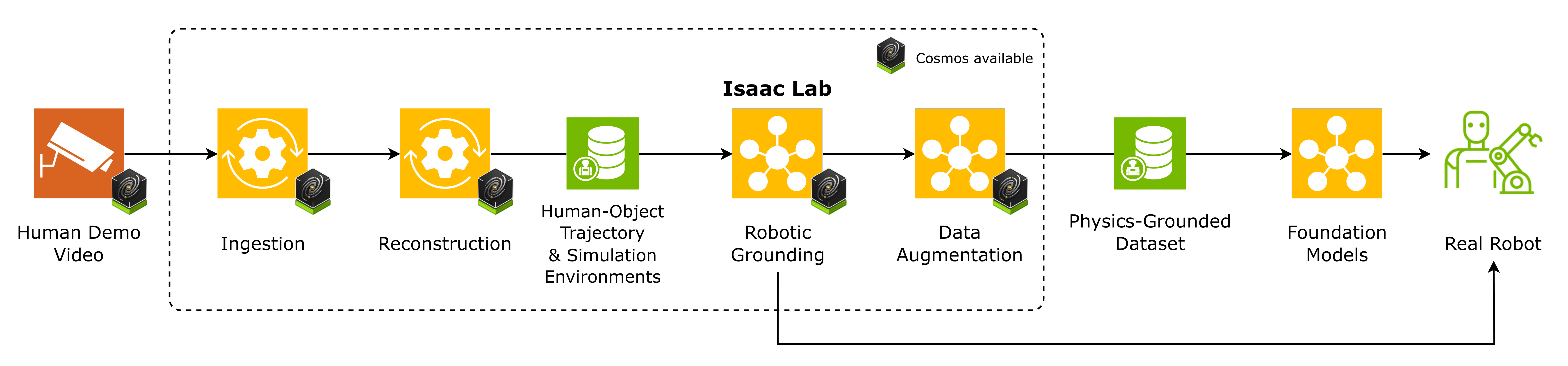
This tutorial motivates Video to Data as a practical bridge from raw demonstrations to actionable robot-learning assets, showing how modern vision-language models, reconstruction tools, and robotic grounding convert everyday video into structured data for learning generalizable robot skills. We teach the pipeline as a sequence of validation gates: queryable video segments, plausible reconstructions, simulation-ready task assets, retargeted motions, and policy-training artifacts.

How can raw human video become robot-usable data?

Participants leave with runnable scripts or notebooks, precomputed artifacts, and an adaptation checklist for deciding whether their own video data is ready for robot learning.

Companion Challenge

We are hosting the Video to Data Challenge! Registrations are now open. Find out more at this link ↗.
Learning Objectives

By the end of the tutorial, participants will be able to:

01
Make video queryable — segment long videos, build entity graphs, store frame embeddings, and retrieve task-relevant clips with natural-language queries.
02
Inspect reconstructions — evaluate depth, object masks, meshes, hand/body reconstructions, 6D object poses, and temporal alignment for geometric plausibility.
03
Convert to robot-facing data — map reconstructed interactions into motion files, object assets, URDF/USD paths, support surfaces, contact fields, and quality checks.
04
Connect to dexterous policy learning — run or inspect a small Isaac Lab training/evaluation example and see how tracking, contact rewards, and rollouts use demonstration-derived data.
05
Diagnose failure modes — identify poor video quality, mask errors, mesh-scale mistakes, drifting poses, invalid retargeting, infeasible support geometry, and weak contact grounding.

Hands-on Format

A guided coding session: short conceptual introductions followed by runnable exercises.

Because full reconstruction and policy training can require GPUs, every exercise has three paths: laptop-only inspection, optional live GPU execution, and precomputed artifacts — so every attendee can complete the objectives.

Code-first pacing

Each module begins with a brief explanation, then moves quickly to an exercise.

Paired debugging

Participants compare retrieved clips, overlays, pose tracks, motion-schema fields, and simulation rollouts.

Validity decisions

Groups classify outputs as ready, questionable, or unsuitable for robot learning.

Live demos

Instructors run selected reconstruction overlays and a short Isaac Lab dexterity run.

Exercise checkpoints

Each exercise produces a visible artifact: a JSONL clip list, retrieved clip, mesh/pose overlay, retargeted motion file, scene viewer, or policy rollout.

Tentative Schedule

2:00 PM – 2:05 PM
Setup and pipeline map
2:05 PM – 2:20 PM
Exercise 1: make a video queryable
2:20 PM – 2:35 PM
Exercise 2: reconstruct a human demonstration
2:35 PM – 2:50 PM
Exercise 3: convert reconstruction results to robot tasks
2:50 PM – 3:05 PM
Exercise 4: train or evaluate a dexterity task in Isaac Lab
3:05 PM – 3:20 PM
Exercise 5: leverage an AI agent
3:20 PM – 3:25 PM
Guided extension: failure diagnosis and bring-your-own-data
3:25 PM – 3:30 PM
Wrap-up and feedback
3:30 PM – 4:00 PM
Poster session and coffee break
4:00 PM – 5:00 PM
Panel discussion: future of learning from human videos
5:00 PM – 6:00 PM
Video to Data Challenge: winner announcement and top-team presentations

Instructors

Each instructor owns a distinct pipeline stage and supports the hands-on exercises, artifact clinics, and debugging sessions.


Yan Chang
NVIDIA
Tutorial coordination and robot-learning validation.
Xinghao Zhu
NVIDIA
Holistic pipeline and simulation-ready robot task conversion.
Mrinal Verghese
Mrinal Verghese
NVIDIA
Video ingestion, entity graphs, embeddings, and natural-language retrieval.
Bowen Wen
NVIDIA
Reconstruction: depth, masks, meshes, and 6D pose tracking.
Zeo Liu
NVIDIA
Dexterous policy training and agentic workflow.
Shalin Jain
Shalin Jain
NVIDIA
Whole-body dexterous manipulation, retargeting, contact rewards, and rollouts.

Participant Materials

Materials will be public and useful even for participants who do not use NVIDIA infrastructure after the event.

The post-tutorial artifact will include
Setup instructions and a lightweight laptop inspection path.
Runnable scripts or notebooks for each exercise.
Sample videos, precomputed outputs, and annotated result folders.
Isaac Lab configs, troubleshooting notes, and example policy rollouts.
A video-to-robot-data validation checklist for adapting the workflow to new data.

We encourage participants to bring their own data questions and use the final guided extension to decide whether their videos are ready, need preprocessing, or need additional sensing or annotation.

Organizers

Xinghao Zhu
Xinghao Zhu
NVIDIA
Website ↗
Yan Chang
Yan Chang
NVIDIA
LinkedIn ↗
Zixi (Zeo) Liu
Zixi (Zeo) Liu
NVIDIA
LinkedIn ↗
Bowen Wen
Bowen Wen
NVIDIA
Website ↗
Mrinal Verghese
Mrinal Verghese
NVIDIA
Website ↗
Shalin Jain
Shalin Jain
NVIDIA
Website ↗
John Welsh
John Welsh
NVIDIA
LinkedIn ↗
Daniel Zou
Daniel Zou
NVIDIA
LinkedIn ↗
Abrar Anwar
Abrar Anwar
NVIDIA
Website ↗
Naema Bhatti
Naema Bhatti
NVIDIA
LinkedIn ↗
Michael Lin
Michael Lin
NVIDIA
Website ↗
Kuan Fang
Kuan Fang
Cornell University
Website ↗
Joydeep Biswas
Joydeep Biswas
UT Austin
Website ↗

Contact

For questions about the tutorial, please contact the organizing team.